Three independent developers built Vampire Hunter: Nightrise in ten months, and AI was integral to the process.
Most people have heard stories about AI producing slop and replacing human labour. This page aims to expand that conversation by telling two others.
The first is about quality: tools that let skilled creators say yes to more ideas and focus more of their attention on the parts that carry meaning.
The second is about access rather than replacement: bringing ambitious work into existence that otherwise would not have been possible, without waiting for institutional permission in an economy where financing is rapidly disappearing.
Let’s start with quality.
Substance vs Slop
There is a legitimate concern that mindless generation will produce soulless garbage. But that conversation often skips the harder question: what gives a work a soul in the first place? The ability to generate a 3D model of a werewolf enemy, for example, does not answer:
Why does the game need a werewolf? What does it mean that it’s here?
What role does it play? How should it move? What should the player feel when it appears? How does its shape relate to the other creatures, the architecture, the combat system and the meaning of the world? For that matter, how does our narrative progress, with respect to werewolves or anything else? How do we reflect player choices back to them? What does it mean to reflect player choices? What does it mean to reflect at all — given this is a game about a vampire who, famously, cannot reflect? What art are we making here? What are we saying about the world, and about people? What are we saying about evil, and good?
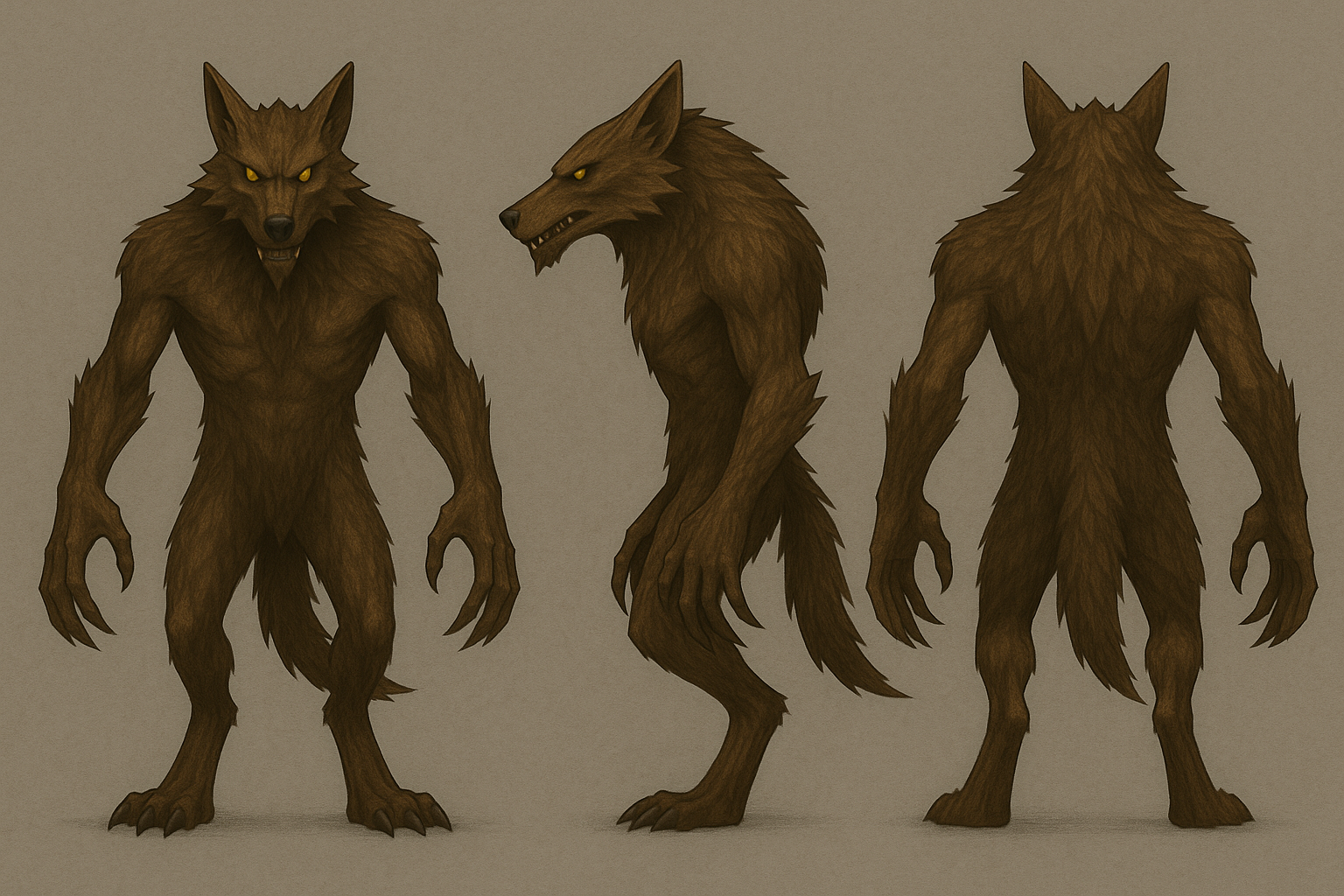
Artistic authorship does not live equally inside every polygon. It lives across the work — in intention, juxtaposition, rhythm, selection, rejection and coherence.
AI did not take this aspect of the project away; it freed us up to do more of it.
The Freedom to Add Meaning
Game development is usually the discipline of saying no. There are always more good ideas than time, money, and people available to execute them, and if you don’t make hard decisions, you go broke, and the game never ships.
Every new enemy needs concept work, modelling, texturing, rigging, animation, visual effects, sound, code, testing, and encounter design. A single enemy can require weeks or months of work before the later process of playtesting and gameplay polish even begins. That’s extremely expensive and time consuming.
Small teams therefore survive not only by cutting ideas, but by refusing to explore them in the first place. Scheduling a month for an experiment that may not work is often too dangerous. Projects run out of money. Games remain unfinished. The risk is real.
For us, AI changed the cost of saying yes. We could focus less on the technical details of making content and more on making sure that what was there was fun, meaningful, rich, and beautiful, and almost more importantly, that there was a lot of variation.
Because of our process, we built many more mechanically distinct enemy types than a project of our size could, ordinarily. Their armour can be shot away. They react to slow-motion fields. Some can lose a leg and continue hopping toward the player. Feral vampires mob the hunter but recoil from the holy light of the cross. Enemies can be launched with a stake, pinned to walls, blasted through doors. They can be lit on fire. They can be stunned, launched, and turned into holy explosions. Most importantly, they are organized. The game is a tight series of interesting encounters that change from area to area, not a mindless slog through enemies, because we had the time and ability to really think about enemy placement and behavior. About making sure we had enough time and space for narrative. That we had rich and interesting upgrades. We could spend our time on what really mattered.
Vampire Hunter: Nightrise is a tight, three-hour experience made in ten months. I’ve been making games for thirty years now. I believe that in the pre-AI era, the amount of complex, 3D animated content we have, given that timeline, is tantamount to impossible. We simply couldn’t have done it.
This process gave us the room and flexibility to not create slop, but to criticize and tighten our own work. If parts of the game were becoming boring and repetitive, it was actually feasible to implement more enemies and encounter types. The time that would have gone into modeling and texturing these entities could be spent on serious design problems, or visual effects that still just require a human to build them. AI allowed us to reach for more high-quality content and gave us the room to polish it properly.
Simply put:
We Could Play Again
High production costs and time delays do more than limit scope. They change how artists think.
When an idea requires several days of specialist work, it must be justified. The team must predict whether it will work, document it, schedule it and defend its cost in advance. But that doesn’t always work; no creative fully understands their project while they’re making it. That means that halfway through the project, the writer (hello!) will inevitably have a bright idea for the lore or world structure that makes everything make more sense – maybe something that unifies some of our systems, and adds depth. However, if people’s time is already accounted for, we may not be able to just pivot and implement this idea. This is the reality of game design – “It’s a tough break, but we have what we have, and we have to live with it.”
For example, we had an empty spot in our map and I realized that we really needed a small hidden workshop where these little creepy dolls were assembled. These dolls have meaning in our lore, and because I could generate those dolls, this was something that I could implement in a few hours. I didn’t need to justify it to a team and pull someone off another task. I wasn’t even sure yet if it would work; but I was free to try. I could just add richness and depth that we couldn’t otherwise have added.
We could experiment with musical ideas in the same way.
One single wing of the castle contains floating islands suspended in a void, a labyrinth of children’s bedchambers and a dining hall built around a massive, undulating pile of rotten food. A player moving quickly might spend only ten minutes in each area. Under ordinary production constraints, those areas might have shared one piece of music — but instead, each now has its own musical identity. Add to that short passages for moments that would rarely justify a separate composition budget: entering the castle, confronting temptation, or discovering an unusual object.
These details are economically frivolous. To my knowledge, no responsible production of this budget and schedule could commission this much high-quality bespoke music from a human composer at fair rates. I can understand the desire to ensure human employment — truly — but this isn’t a choice between hiring a human and not hiring one.
The human-composed, human-modeled, fully staffed version of Nightrise was imaginary. It could not exist.
And that leads us to the second story:
We Could Build Without Waiting for Permission That was Never Coming
The independent game economy is in crisis.
Funding has been harshly contracted. Publishers are more cautious. Unusual projects are difficult to evaluate and expensive to prove.
Before Nightrise, we spent months pitching a different game, called Kill Joy — building the vertical slice, approaching publishers, waiting on decisions. That pitch process took roughly as long as the entire production of Nightrise did. Careful readers will notice that constitutes a rather silly double bind; I can now make a great game in the time it takes to pitch publishers to get money to make that game. What?
The game we were pitching was good; material from it later pulled millions of views online. But “good” doesn’t shorten the process, or guarantee success — and rightly so. Publishers are cagey and studios are closing. The conventional path asks a small team to spend a meaningful share of its time and money asking permission before development can even begin. For Nightrise, we opted out.
Historically, an alternative would not be obvious. We could attempt to assemble a much larger group of independent developers, divide ownership many ways and — in an industry where game prices are plummeting and companies are going bankrupt — ask everyone to gamble a year of their lives for a tiny slice of a very uncertain commercial result.
We have families to support. Most independent games do not become breakout successes. Hope is not an economic model.
The alternative of a fully funded production staffed by fairly paid specialists was imaginary. The real, practical alternatives were a drastically smaller game, an irresponsible financial gamble, a long search for institutional permission — or no game at all.
AI gave us another path. And it didn’t require justifying our art to an external arbiter. It freed us to create the content that we believed was meaningful.
And finally:
We Could Finish Strong
A game can be imaginative and still fail its players if it ships unstable. AI helped us test more, investigate problems faster, and spend less of our final production window manually chasing bugs.
AI coding tools have become sophisticated enough that they can, in many cases, autonomously examine several interacting systems and identify edge cases that cause bugs far faster than our previous process of reproducing the issue, inserting logs and isolating the fault by hand. In many cases, a bug can be pasted into an AI chat window and — while you think about more important things that lead to a richer gameplay experience — the bot will track down the issue and fix it.
That did not remove the need for technical understanding. We had to describe the systems, evaluate the diagnosis, reject bad solutions, test the implementation and accept responsibility for the result.
It helped us fix more, and approach release with a more stable game than our schedule would otherwise have allowed.
The Concerns About AI Are Real
None of what I have laid out here negates other valid concerns. Generative AI raises serious questions about work, ownership, power, energy, water and the kind of culture we are building.
Those questions deserve honest public discussion. Not every use of AI is worthwhile. Not every deployment is responsible. Cheap generation can produce enormous amounts of noise, waste and disposable material when no one is exercising judgment.
For Nightrise, the scarce ingredient in production was not assets. It was conscious attention.
With conscious attention, we can use these tools to make truly beautiful things. If we use them thoughtlessly in a vapid attempt to outsource responsibility and get-rich-quick, we will make slop, and we will cause waste in the process.
We are not asking anyone to stop asking what AI costs.
We are asking that the conversation also make room for what it creates — who it empowers, and what becomes possible when a small number of people are given greater reach.